Comment on proposed EPA Hydraulic Fracturing Air Pollution Rules

To: Air Quality Office of the US EPA
From:League of Women Voters of West Virginia
Re: EPA Hydraulic Fracturing Air Pollution Rules, proposed

The League of Women Voters of West Virginia applauds the US EPA for issuing regulations on air emissions from fracking to drill for natural gas and oil. At present West Virginia residents are among those bearing the brunt of increased air pollution from fracking to produce natural gas from the Marcellus Shale.

We recognize the economic benefits from gas well drilling, but these benefits should not be at the expense of the health of our people. Regulation of VOCs and air toxics is necessary to protect our citizens’ health.

In addition the release of methane from gas wells contributes to the warming of the planet so we strongly support measures to eliminate fugitive methane releases.

We also support requiring existing wells be covered by the same air pollution regulations.

We are impressed with the proposed savings to the industry when they install the necessary measures to meet the requirements of the regulations.

Thank you for your efforts to improve the public health of residents in fracking/drilling areas.

2011 Natural Resources Convention Report

CONVENTION. 2011.INFORMATION

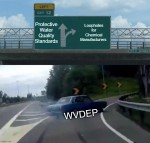
(Coal Tattoo, 4.26.11) Well, WVDEP Secretary Randy Huffman called it the worst ruling I’ve ever seen out of the EQB as far as a lack of respect for the rule of law, so it probably is no surprise that the agency has appealed the state Environmental Quality Board’s decision in the case over International Coal Group’s New Hill West surface mine in Monongalia County.

I’ve posted a copy of the WVDEP appeal, filed in the circuit court of Kanawha County, here. Among other things, WVDEP lawyers argue in the appeal:

The board’s findings that numerous scientific studies have shown that declines in stream macroinvertebrate communities directly downstream of surface mining operations are caused by the combined effects of heightened concentrations of ions was clearly wrong in the view of the reliable, probative and substantial evidence in the record.

CLEAN WATER ACT, GUIDANCE, 4.27.11

(Sustained Outrage. 4.27.11) Big clean water news out today from the Obama administration. As announced by the U.S. Environmental Protection Agency:

Recognizing the importance of clean water and healthy watersheds to our economy, environment and communities, the Obama administration released a national clean water framework today that showcases its comprehensive commitment to protecting the health of America’s waters. The framework emphasizes the importance of partnerships and coordination with states, local communities, stakeholders and the public to protect public health and water quality, and promote the nation’s energy and economic security.

The move was also announced by the White House, and a key part of all of this is major new Clean Water Act guidance by the EPA:

Americans depend on clean and abundant water. However, over the past decade, interpretations of Supreme Court rulings removed some critical waters from Federal protection, and caused confusion about which waters and wetlands are protected under the Clean Water Act. As a result, important waters now lack clear protection under the law, and businesses and regulators face uncertainty and delay. The Obama Administration is committed to protecting waters on which the health of people, the economy and ecosystems depend.

U.S. EPA and the U.S. Army Corps of Engineers have developed draft guidance for determining whether a waterway, water body, or wetland is protected by the Clean Water Act. This guidance would replace previous guidance to reaffirm protection for critical waters. It also will provide clearer, more predictable guidelines for determining which water bodies are protected by the Clean Water Act. The draft guidance will be open for 60 days of public comment to allow all stakeholders to provide input and feedback before it is finalized.

The draft guidance will reaffirm protections for small streams that feed into larger streams, rivers, bays and coastal waters. It will also reaffirm protection for wetlands that filter pollution and help protect communities from flooding. Discharging pollution into protected waters (e.g., dumping sewage, contaminants, or industrial pollution) or filling protected waters and wetlands (e.g., building a housing development or a parking lot) require permits. This guidance will keep safe the streams and wetlands that affect the quality of the water used for drinking, swimming, fishing, farming, manufacturing, tourism and other activities essential to the American economy and quality of life. It also will provide regulatory clarity, predictability, consistency and transparency.

As The Washington Post explained:

It remains unclear what portion of the nation’s waterways will now come under stricter regulation. After the Supreme Court issued rulings that questioned whether the Clean Water Act applies to isolated streams that are not connected to navigable waterways, Bush officials said as many as 20 million acres of wetlands fell under that category.

The EPA has also abandoned more than 1,500 pollution probes in recent years, given the uncertainty surrounding what qualifies as “waters of the United States.”

You can read the proposed guidance here, and EPA has posted some cost-benefit studies on this guidance here and here, and this Sierra Club report has some interesting background, as does this report from the Congressional Research Service.

It’s not surprising that West Virginia’s members of Congress signed onto a letter opposing this action by EPA.  Earthjustice, meanwhile, had kind words for the EPA’s move:

For nearly a decade the Clean Water Act has been broken and left thousands of streams, rivers and wetlands exposed to oil spills, fills and destruction, and other industrial discharges from polluters.

This pollution has not only left our waters dirty, it has threatened the millions of Americans who depend on these waters for drinking. The Obama administration’s new guidance reinstates most of the protections of the Clean Water Act, although there are some important water bodies that may still be left unprotected until Congress addresses this issue. This is an important step forward to fix a Bush-era guidance that sacrificed our waters for the sake of special interests.

This new guidance now will be subject to public comment. We know the American people want, expect, and deserve clean water for their families and communities. We hope they will speak up now to support the Obama administration’s efforts to keep our nation’s waters protected from pollution.

EPA – Q & A

Q. Why is the US Environmental Protection Agency (EPA) essential to our well being?

Ans. The mission of the EPA is to protect human health and the environment. Using the best scientists, the law, and public input the EPA is charged with reviewing scientific data, monitoring industrial processes, and developing appropriate controls

Q. How has our country benefited from the Clean Air Act Amendments?

Ans. A recent EPA report shows that “in 2010 alone, the reductions in fine particle and ozone pollution  prevented more than:  160,000 cases of premature mortality, 130,000 heart attacks, 13 million lost work days, and 1.7 million asthma attacks… The direct benefits from the 1990 Clean Air Act Amendments are estimated to reach almost $2 trillion for the year 2020, a figure that dwarfs the direct costs of implementation ($65 billion).”

Q. Why does the EPA need to update regulations under the Clean Air Act?

Ans. To control toxic air pollutants and limit pollutants that are causing global climate change.

Q. Why should the EPA control CO2 emissions?

Ans. Science shows that rising average temperatures, caused by increases in CO2 and other greenhouse gases, are already affecting the global climate. These changes will result in extreme weather events, flooding, social disruptions, threats to human health, habitat destruction, and alterations in food production.

Q. Why does the EPA intervene in coal mining permits?

Ans. The Clean Water Act gave the EPA the responsibility to oversee the impacts of mining and other practices on our waters. Mountain Top Removal mining has destroyed over 2,000 miles of headwater streams so far.

Q.. Why is the EPA mandating that runoff from West Virginia and other states in the Chesapeake Bay watershed and its tributaries be controlled?

Ans. The Chesapeake Bay is the country’s largest estuary and historically its harvest was abundant. The Bay is also a center for recreation for millions of people. Through the years agricultural runoff and untreated sewage have degraded the Bay’s ecosystem causing a crash in harvesting oysters and other aquatic sources of food. Voluntary efforts to clean up the Bay and its tributaries have been unsuccessful. The time has come to mandate a reduction in the nutrients and sediment ending up in the Chesapeake Bay.

Q. Why are many in Congress and others trying to emasculate the EPA by working to keep the EPA from controlling CO2 and toxic air pollutants, and restricting its regulatory powers over water pollution?

Ans. I don’t know.

doc iconEPA.doc

Fears voiced at Marcellus Shale hearing

Today at a public hearing with state legislatures focused on Marcellus Shale Drilling in West Virginia

Marilyn McGeorge, from the League of Women Voters, said, “The League supports a strong regulatory plan. Today, there are only 17 field inspectors to cover new drilling sites, in addition to 157,000 sites already operating. And there will be six million gallons of water used in each well.”

See full article at http://wvgazette.com/News/201102171508.

Jan. Natural Resources Report to the State Board

WV Legislative Priority, 2011

The LWVWV supports the regulation of horizontal/Marcellus Shale drilling for natural gas in order to protect the nearby residents and the environment (water, air, and land.) We will also support other environmental bills as action is needed.

MARCELLUS SHALE/HORIZONTAL DRILLING

Two bills will be submitted to the legislature – The interim committee’s bill and the WVDEP’s. Both bill drafts are long (more than 100 pages long) and legally and technically complex. The DEP’s bill includes a new fee on horizontal wells that would add 34 people to the oil and gas office’s staff, including increasing the number of inspectors from 18 to 36. This fee is necessary to enforce a new law and subsequent regulations. Don Garvin has written a comparison of the bills. See the Environmental Council’s Green Legislative Update, January 14 for an extensive review of the bills. Neither bill covers air pollution from MS operations or permits for large water withdrawals. Neither bill establishes a permit system for large water withdrawals. (The League contacted the legislators on the committee asking them to pass out the bill.)

Water Quality Standards Rule Advances (From Environmental Council’s Legislative Update, Jan. 14)

“The Joint Legislative Rulemaking Review Committee passed WV DEP’s proposed changes to the Water Quality Standards Rule (47CSR2) with no changes at its last Interim meeting Monday evening. It’s now ready for consideration by the full Legislature. The rule contains a new water quality standard for Total Dissolved Solids (TDS) of 500 mg/l “in stream”, which is stricter than Pennsylvania’s standard of 500 mg/l at a public water supply intake. TDS is primarily chemical salts associated with mining and oil and gas activities. The changes proposed in this rule are required by EPA under the Triennial Review provisions of the federal Clean Water Act. (The League sent comments on the rule during the rule making process.We also contacted all the legislators on the LRRC Committee asking them to vote to pass out the rules.)

Bill to Ban Coal Slurry Injection Advances (From Environmental Council’s Green Legislative Update, January 14)

The Interim Joint Legislative Judiciary Committee passed out a bill that would permanently ban the injection of coal sludge into underground coal mines, with “recommendation” that it be passed by the full Legislature. The bill contains tax incentive provisions for coal companies who upgrade to new technologies for dealing with the waste that results at coal prep plants. Thus both houses will submit a bill on this issue.

The U.S. Environmental Protection Agency vetoed the proposed Spruce No. 1 Mine.

This veto of the U.S. Army Corps of Engineers’ approval of the mine proposed for the Blair area of Logan County, is for 2,300 acres, the largest single mountaintop removal permit in West Virginia history. See the Coal Tattoo Blog, Charleston, Gazette for full information on the denial of the permit.

The WV League has asked the LWVUS for permission to contact the USEPA commending the agency for its action. Meanwhile as individuals you may wish to contact Lisa Jackson, administrator of the EPA., JACKSONLISAP@EPA.GOV.

Bayer to Phase Out MIC

Bayer CropScience announced Tuesday that it will stop making, storing and using the deadly chemical methyl isocyanate MIC at its Institute plant as part of a corporate restructuring. Unfortunately 220 jobs will be lost, but workers and the community will be safer.

Water Pollution in Drinking Wells, Wood County. (From Sustained Outrage Blog, by Ken Ward, Charleston, Gazette, January 4)

A study of drinking wells in the Parkersburg area concludes: Private drinking water wells in West Virginia and Ohio communities surrounding the DuPont Washington Works facility are contaminated with PFOA. Concentrations in private wells are, in some cases, much greater than those observed in area public water districts…. PFOA (also known as C8) is used in the manufacture of Teflon® nonstick polymers. PFOA has been shown to increase risk of cancer, reproductive problems, and liver damage in laboratory animals, although human health effects are less clear.

COAL ASH DISPOSAL (From Nov.30.2010 Coal Tattoo)

Nearly two years ago, 978,000,000 gallons of wet coal ash spilled into the Emory River and its tributaries near Kingston, Tenn. Now researchers from Duke University report that the spill polluted downstream sediments with unexpectedly high levels of a particularly toxic form of arsenic.

Vermont Law School’s Environmental Watch List 2011 (http://watchlist.vermontlaw.edu/)

Two of the items on the list are of special interest to those of us who live in WV.

1. Climate and Energy Legislation and the International Treaty Process on Climate. The article gives reasons why the legislation died in the last Congress and what the future might bring.

2. Protecting EPA’s greenhouse gas rules.

The WV League is asking the LWVUS to include protection of the rules as a legislative priority. The Rules include increasing the gasoline standards for automobiles and trucks. Also on May 13, 2010, the EPA issued the greenhouse gases “tailoring rule”, to regulate stationary sources under the Clean Air Act’s New Source Review and prevention of Significant Deterioration (PSD) program.

WV’s members of Congress have been working to stop this rule because it will affect the use of coal for power production and industry.

Urge Lawmakers to Pass Marcellus Shale Drilling Bill Out of Subcommittee

Last month the Joint Legislative Interim Judiciary Subcommittee A introduced a draft bill establishing a new regulatory program for gas wells utilizing horizontal drilling and hydraulic fracturing.  While the bill is aimed at regulating the Marcellus Shale gas well drilling occurring now in West Virginia, it would apply to all drilling using these new drilling techniques.

The subcommittee will begin discussing this important bill as early as next Monday, December 13, at their monthly interim committee meetings. Our preliminary reading of this draft legislation shows that it contains some good things and some not-so-good things, and omits some things we want.

But it is important that the subcommittee pass a bill out before Interim sessions end in January, so that the full legislature will have a comprehensive draft bill to consider when they convene on January 12.

Some background:
Conventional natural gas drilling and production is a major industrial activity with a host of environmental and other consequences. Effects can range from water contamination related to drilling and disposal of drilling fluids, air quality degradation from internal combustion engines on drill rigs and trucks, excess dust from equipment transportation, impacts to solitude and night skies from noise and lighting, and safety concerns associated with the large number of trucks needed to support drilling operations. However, “unconventional” shale-gas drilling, such as in the Marcellus Shale play, represents a huge leap in technology, and causes an exponential increase in surface disturbance, water use and waste disposal. And all this new activity is largely unregulated in West Virginia.

Please contact NOW the members of Interim Judiciary Subcommittee A and urge them to pass this comprehensive draft legislation out of subcommittee and on to the full legislature for its further consideration. Committee members need to know their constituents are concerned about the greater impacts of Marcellus and other deep shale drilling and this bill is a crucial start.  Including comments about problems you’ve experienced or know about in other areas of the state is helpful, but not necessary.

The industry has already made its opposition to this bill known — now it’s time for legislators to hear from YOU.

Below is a list of Judiciary A Subcommittee members and their contact information.  You can also try to contact (and leave messages for) members using the Toll Free phone number: 1-877-565-3447.

You may use this action alert page provided by the Sierra Club to email all members!

Thanks for your help.

Continue reading Urge Lawmakers to Pass Marcellus Shale Drilling Bill Out of Subcommittee

Pittsburgh Bans Natural Gas Drilling

Adopts first-in-the-nation ordinance – elevates the right of the community to decide, not corporations

Continue reading Pittsburgh Bans Natural Gas Drilling

WV Sierra Club Member to Speak on Impact of Marcellus Shale Drilling

Sponsored by the League of Women Voters of Morgantown-Monongalia County

Wednesday, December 8th
7-9 pm Aull Center
351 Spruce St.

The West Virginia Chapter of the Sierra Club has initiated a campaign to protect our waters and communities from the hydro-fracking process, and other environmental abuses, associated with drilling for gas in the Marcellus Shale rock formations of the Appalachian Mountains.  Beth Little, who is a member of the Sierra Club’s Campaign Steering Committee, will be giving a presentation about the environmental risks associated with Marcellus Shale drilling.

The League of Women Voters invites the public to come to the Aull Center Wednesday evening, December 8, 7-9 p.m. Refreshments will be served after the presentation.

Nov. Natural Resources Report to the State Board

Legislative Proposals

Here is the Environmental Council’s #1 2011 legislative priority – Marcellus Shale Drilling plus the need for more inspectors. Other items they will be following will be the Water Quality Standards Rule, Ending Coal Slurry Injection, Regulation of Coal Ash, and Renewable Energy Incentives.

The Water Quality Standards Rule (see state board report, September, 2010.) The League is particularly interested in seeing that the Total Dissolved Solids rule is approved by the legislature.

Marcellus shale. PROPOSED LEGISLATION (From the Charleston Gazette)

A legislative interim committee has been considering what measures the state should take to minimize environmental and social problems that come from drilling for gas in Marcellus Shale formations. The interim committee is looking at a 90-page draft law. One problem is that the state’s inspection program is tremendously under staffed so the draft proposes increasing permit fees to help ameliorate that problem. At present fees for shallow wells are $600 but the proposal would establish fees for Marcellus Shale drilling ranging from $5,000 to $15,000 per well. Obviously the natural gas drillers object to such rates saying they could cripple the industry. Legislation also will consider water pollution, water withdrawal and disposal, erosion, and road destruction.

The WV DEP is also preparing a bill similar to the committee’s draft. Both drafts require comprehensive water management plans, including listings of chemicals to be used in fracking fluids, and measures to control water consumption and waste. Both also require erosion and sediment-control plans, reclamation and replanting of disturbed lands, and the lining of large open pits, or impoundments, to prevent salt and chemicals from leaching out. But the committee’s version tackles some issues the DEP didn’t, including the spacing of wells, road protection and the performance bonds, which industry says would be a hardship on smaller companies. The DEP’s version will raise fees, too, but it is not known how much.

Continue reading Nov. Natural Resources Report to the State Board

Fall Natural Resources Report

Actions Taken

1. Comments to ORSANCO, asking the agency not to weaken standards for mercury in the Ohio River.

2. Comments to the Oil and Gas Office of the WV Department of Environmental Protection regarding the reclamation of oil and gas sites. The League asked that (1) the DEP require the use of native plants for revegetation rather than the list proposed that is made up of non-native, invasive plants, and (2) that the uses of the held topsoil shall be re-spread or used as a top dressing, rather than should.

3. We joined with other WV environmental organizations on comments to the DEP on the 2010 Triennial Review of WV Water Quality Standards. Thanks to the other organizations for their preparation of the comments. Salient parts are listed here: Continue reading Fall Natural Resources Report